- Community
- Discord(JEE)
- Telegram(JEE)
- Categories
- All Physics Books
- All Chemistry Books
- All Maths Books
- Coaching Materials
- All PYQ Books
- All Test Series
- Class 9 Study Material
- Class 10 Study Material
- Hand Written Notes
- Hand Written Shortnotes
- NCERT
JEE Chemistry Books Collection
Last Updated: September 2026
A curated collection of the most recommended Chemistry books for JEE Main and Advanced. Covering Physical, Organic, and Inorganic branches, these resources from top authors will help you master concepts and solve problems effectively.
Complete your physical library with the top recommended Chemistry books for JEE preparation.
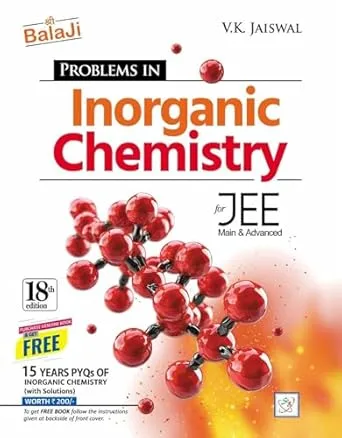
V.K. Jaiswal - Problems in Inorganic Chemistry
V.K. Jaiswal's Problems in Inorganic Chemistry — an objective problem bank covering Chemical Bonding, Periodic Properties, s-block, p-block, d & f-block, Coordination Compounds, Metallurgy and Qualitative Analysis. The most reliable way to convert NCERT inorganic facts into exam-ready recall for JEE Advanced.
September 20, 2026
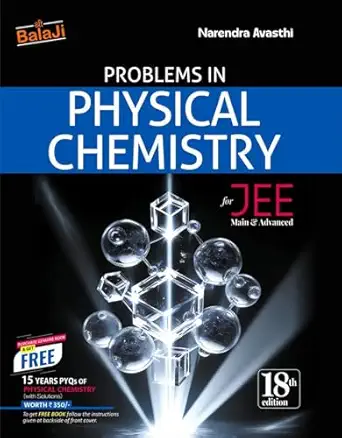
Narendra Avasthi - Problems in Physical Chemistry
Narendra Awasthi's Problems in Physical Chemistry — covers Mole Concept, Atomic Structure, Gaseous State, Thermodynamics, Chemical and Ionic Equilibrium, Electrochemistry, Kinetics, Solid State, Solutions and Surface Chemistry. Its Level 1, 2 and 3 exercises map directly onto JEE Main and Advanced difficulty.
September 20, 2026
M.S. Chauhan - Elementary Problems in Organic Chemistry
M.S. Chauhan's Elementary Problems in Organic Chemistry — built around single-step and two-step reactions across GOC, Isomerism, Hydrocarbons and the common functional groups. It deliberately avoids Advanced-level stereochemical traps, which makes it the right starting problem book for JEE Main and NEET.
September 20, 2026
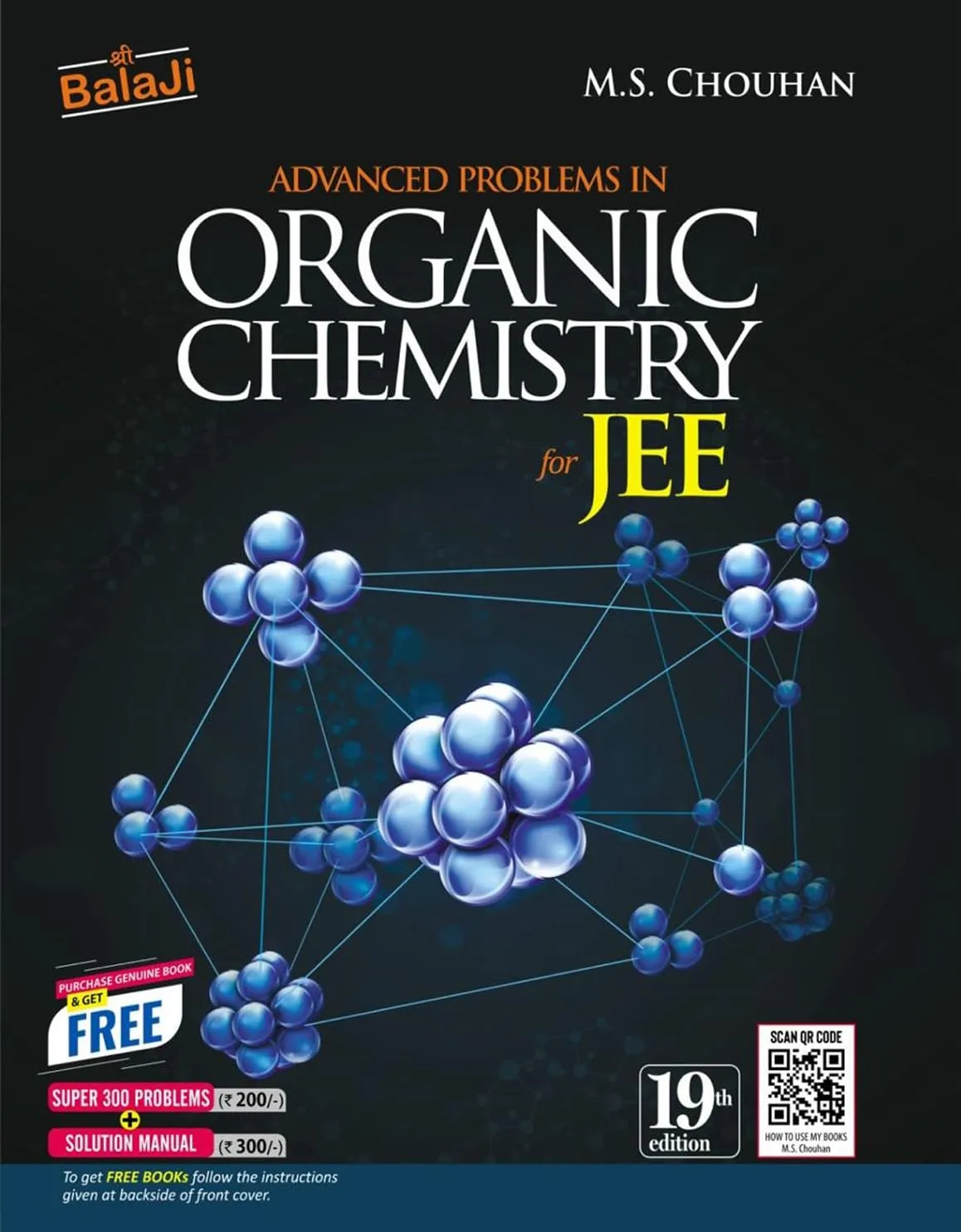
M.S. Chauhan - Advanced Problems in Organic Chemistry
M.S. Chauhan's Advanced Problems in Organic Chemistry — the three-part set covering GOC and Isomerism, Hydrocarbons and Alkyl Halides, Alcohols, Ethers and Carbonyl compounds, through to Carboxylic Acids, Amines and Biomolecules. Expect multi-step synthesis and stereochemistry-heavy questions built for JEE Advanced.
September 20, 2026
Himanshu Pandey - Advanced Problems in Organic Chemistry
Himanshu Pandey's Advanced Problems in Organic Chemistry — thousands of application-based MCQs spanning GOC, Isomerism, Hydrocarbons and every major functional group, paired with a detailed solutions manual. A strong alternative or supplement to M.S. Chauhan for JEE Advanced organic practice.
September 20, 2026
J.D. Lee (Sudarshan Guha) - Concise Inorganic Chemistry
J.D. Lee's Concise Inorganic Chemistry, adapted for JEE by Sudarsan Guha — explains the reasoning behind periodic trends, chemical bonding, and the behaviour of the s, p, d and f blocks. Use it as a reference to understand the NCERT 'exceptions' rather than memorise them.
September 20, 2026
Solomons & Fryhle - Organic Chemistry (M.S. Chauhan Adaptation)
Solomons & Fryhle's Organic Chemistry, adapted for JEE by M.S. Chauhan — the internationally used theory text covering structure and bonding, stereochemistry, reaction mechanisms and every major functional group, with electron-pushing arrows drawn for each step. The best book for genuinely understanding organic mechanisms.
September 20, 2026
K.S. Verma - Cengage Chemistry
K.S. Verma's Cengage Chemistry — a six-book series splitting Physical, Organic and Inorganic Chemistry into Class 11 and Class 12 volumes. Each book pairs complete theory with graded exercises, making the set a self-sufficient replacement for coaching modules across the whole JEE syllabus.
September 20, 2026
O.P. Tondon - GRB Physical Chemistry
O.P. Tandon's GRB Physical Chemistry — covers Mole Concept, Atomic Structure, Gaseous State, Thermodynamics, Equilibrium, Electrochemistry and Kinetics with unusually patient explanations. Best suited to building core theory before switching to a dedicated problem book.
September 20, 2026
Dr. P. Bahadur - GRB Numerical Chemistry
Dr. P. Bahadur's GRB Numerical Chemistry — a classic physical chemistry problem set combining summarised theory, a large bank of solved examples, and hundreds of subjective numericals across mole concept, thermodynamics, equilibrium, electrochemistry and kinetics.
September 20, 2026
How to Study Chemistry for JEE
Divide and Conquer: The biggest mistake students make is treating Chemistry as a single subject. In reality, it is three vastly different disciplines. Your preparation strategy must adapt to each branch.
Physical Chemistry (The Math Approach):
Treat Physical Chemistry exactly like Physics. It relies heavily on mathematical rigor, unit conversions, and conceptual formulas. Focus deeply on foundational chapters like Mole Concept and Thermodynamics.
Strategy: Read theory briefly from class notes, then immediately jump into numerical practice. N. Awasthi is the undisputed champion for building problem-solving speed here.
Organic Chemistry (The Logical Approach):
Organic Chemistry is a continuous chain. If your foundation is weak, you will struggle with every subsequent chapter. Never rote-learn reactions. Always understand the movement of electrons (the mechanism).
Strategy: General Organic Chemistry (GOC) and Isomerism are the pillars. Master them first. Use M.S. Chauhan (Elementary) alongside your lectures, and move to his Advanced book when you feel confident.
Inorganic Chemistry (The Memory Approach):
Inorganic is infamous for rote memorization, but there are underlying periodic trends that explain many exceptions.
Strategy: NCERT is your bible. Read it line-by-line. Highlight exceptions. To test your retention, solve objective questions daily from V.K. Jaiswal rather than blindly re-reading the text.
Frequently Asked Questions about JEE Chemistry Prep
Is NCERT enough for JEE Chemistry?
For Inorganic Chemistry, NCERT is the absolute bible and covers nearly 95% of JEE Mains questions directly. However, for Physical and Organic Chemistry, NCERT is excellent for basic theory but insufficient for the level of problem-solving required for JEE Advanced.
Which book is best for Organic Chemistry?
M.S. Chauhan is highly recommended for building a strong foundation in reaction mechanisms and concepts, while Himanshu Pandey is excellent for rigorous, advanced problem-solving practice.
How should I study Physical Chemistry?
Treat Physical Chemistry like Physics. Understand the underlying concepts, memorize the core formulas, and practice extensively. N. Awasthi is considered the gold standard for numerical practice in this domain.
Do I need foreign author books for JEE?
Books like Solomons, J.D. Lee, or Peter Sykes are conceptually brilliant, but it is highly advised to use their Indian adaptations (like M.S. Chauhan's adaptation of Solomons) as they are strictly aligned with the JEE syllabus and pattern.
How can I effectively memorize Inorganic Chemistry?
Consistent, spaced revision is key. Use short notes, flashcards, and make a habit of reading a few pages of NCERT daily. Practice from books like V.K. Jaiswal to test your retention through MCQs.
Support Our Mission
By purchasing through the links below, you help us keep JEE Archive running at no extra cost to you. We receive a small commission from amazon, which directly support the maintenance and growth of this platform.

© 2025 Jeearchive. All rights reserved.
contactjeearchive@gmail.com