- Community
- Discord(JEE)
- Telegram(JEE)
- Similar Resources
- All Chemistry Books
J.D. Lee (Adapted by Sudarsan Guha) - Concise Inorganic Chemistry
Last Updated: September 2026
The Ultimate Reference for Inorganic Exceptions and Theories
Master the complexities of Inorganic Chemistry with the Indian adaptation of J.D. Lee's Concise Inorganic Chemistry by Sudarsan Guha. This book is highly recommended for top-tier JEE aspirants who want to move beyond rote memorization and understand the deep theories behind chemical exceptions.
Build strong inorganic concepts with J.D. Lee, a widely recommended book for detailed theory and clarity for JEE Advanced preparation.
Book Snapshot
- Author: J.D. Lee (Adapted by Sudarsan Guha)
- Publisher: Wiley India
- Best For: Deep theoretical understanding of Inorganic Chemistry for JEE Advanced
- Difficulty Level: Advanced (University Level Theory adapted for JEE)
- Prerequisites: Basic knowledge of the periodic table and chemical bonding
J.D. Lee - Concise Inorganic Chemistry PDF
J.D. Lee Concise Inorganic Chemistry PDF (Sudarsan Guha adaptation) — the complete JEE-tailored edition covering Atomic Structure and Periodicity, Chemical Bonding, the s-Block, p-Block, d-Block and f-Block elements, Coordination Compounds and Metallurgy. Its strength is explaining why periodic 'exceptions' happen, turning memorisation into deduction. Use it as a reference for topics NCERT leaves unexplained, not as a cover-to-cover read.
September 20, 2026
J.D. Lee - Inorganic Chemistry PDF
J.D. Lee Inorganic Chemistry PDF — the full-length edition of the classic text, explaining periodicity, chemical bonding, s-, p-, d- and f-block chemistry and coordination compounds from first principles. Use it as a deep-dive reference alongside the Concise edition when NCERT and the adapted book leave a trend unexplained.
September 26, 2026
Overview, Unique Strengths & Study Strategy
Unique Strengths: Inorganic chemistry is often notorious for its "exceptions." JD Lee's biggest strength is that it proves there are no exceptions, only deeper rules. By explaining the underlying quantum mechanics, shielding effects, and thermodynamic principles, it turns rote memorization into logical deduction.
Target Audience: This book is strictly for top-percentile students preparing for JEE Advanced or Olympiads (NSEC). If your goal is only JEE Mains, reading this book will consume too much time with diminishing returns. Stick to NCERT for Mains.
Study Strategy: Do not read this book cover-to-cover. It is a reference manual. First, read a chapter from NCERT. If you encounter a concept or trend in NCERT that you do not understand (e.g., why the ionization energy dips irregularly in the p-block), open JD Lee to that specific sub-topic and read the explanation. Pay special attention to the chapters on Chemical Bonding and Coordination Compounds, as these are brilliant in JD Lee.
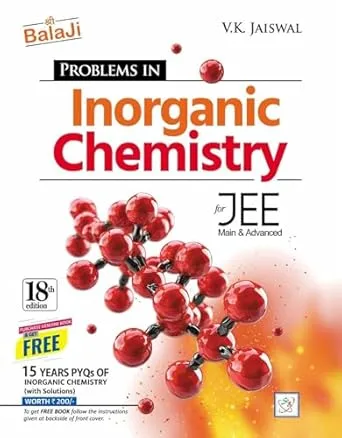
Comparisons & Alternatives: There is no real equivalent to JD Lee in the Indian market for theory depth. For objective practice, you should pair this theory book with VK Jaiswal to test your knowledge against actual JEE Advanced patterns.
Frequently Asked Questions about JD Lee
Is JD Lee good for JEE Advanced?
Yes, it is widely considered the ultimate reference book for Inorganic Chemistry for JEE Advanced, especially for clarifying exceptions and complex bonding theories.
Which version of JD Lee is best for JEE?
The JEE-adapted version by Sudarsan Guha (published by Wiley India) is the best. The original international edition contains too many topics outside the JEE syllabus.
Do I need to read JD Lee cover-to-cover?
Absolutely not. Doing so will waste hundreds of hours. You should strictly use it as a reference book to read specific chapters like Coordination Compounds or p-block elements that you find difficult to understand from NCERT.
JD Lee vs NCERT: Which should I read for Inorganic Chemistry?
NCERT is mandatory and non-negotiable for JEE Mains and base-level Advanced. JD Lee is a supplement for deep dives into specific topics for top-tier Advanced ranks.
Does JD Lee have enough practice problems?
While the Sudarsan Guha adapted version does include MCQs, it is primarily a theory textbook. You should supplement it with a dedicated objective book like VK Jaiswal.
Support Our Mission
By purchasing through the links below, you help us keep JEE Archive running at no extra cost to you. We receive a small commission from amazon, which directly support the maintenance and growth of this platform.
© 2025 Jeearchive. All rights reserved.
contactjeearchive@gmail.com